The association of France with fashion and style (la mode) is widely credited as beginning during the reign of Louis when the luxury goods industries in France came increasingly under royal control and the French royal court became, arguably, the arbiter of taste and style in Europe. The rise in prominence of French fashion was linked to the creation of the fashion press in the early 1670s (due in large part to which transformed the fashion industry by marketing designs to a broad public outside the French courtand by popularizing notions such as the fashion "season" and changing styles.
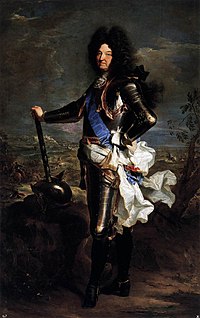
Over his lifetime, Louis commissioned numerous works of art to portray himself, among them over 300 formal portraits. The earliest portrayals of Louis already followed the pictorial conventions of the day in depicting the child king as the majestically royal incarnation of France. This idealisation of the monarch continued in later works, which avoided depictions of the effect of the smallpox that Louis contracted in 1647. In the 1660s, Louis began to be shown as a Roman emperor, the god as can be seen in many works of , such as sculpture, paintings, and the decor of major monuments.
Rigaud's portrait exemplified the height of royal portraiture in Louis's reign. Although Rigaud crafted a credible likeness of Louis, the portrait was neither meant as an exercise in realism nor to explore Louis's personal character. Certainly, Rigaud was concerned with detail and depicted the King's costume with great precision, down to his shoe buckle.[7] However, Rigaud's intention was to glorify the monarchy. Rigaud's original, now housed in the Louvre, was originally meant as a gift to Louis's grandson,. However, Louis was so pleased with the work that he kept the original and commissioned a copy to be sent to his grandson. That became the first of many copies, both in full and half-length formats, to be made by Rigaud, often with the help of his assistants. The portrait also became a model for French royal and imperial portraiture down to the time of X over a century later. In his work, Rigaud proclaims Louis's exalted royal status through his elegant stance and haughty expression, the royal regalia and throne, rich ceremonial fleur-de-lys robes, as well as the upright column in the background, which, together with the draperies, serves to frame this image of majesty.
Louis XIV notably introduced one of the most noticeable feature of the men's costume of the time: immense wigs of curled hair. A commonly held belief is that Louis XIV started to wear wigs due to balding, and to imitate this his courtiers put on false hair.]The wearing of wigs lasted for over a century; they went through many changes, but they were never quite so exaggerated as during this period.

No comments:
Post a Comment